Powerpoint: Octavian Proposes Emperorship

Slideshare is hosting a presentation competition, and this presentation of course caught my eye: A Roman Emperor, presented by Gaius Octavian Caesar


The Team
* Gaius Octavian Caesar, Emperor
Adopted son of a Dictator; vast experience in wielding absolute power over helpless individuals
* Gaius Octavian Caesar, Commander in Chief
Successful campaigns in Mutina and Pilippi; sleeps well in tents while others fight
* Gaius Octavian Caesar, High Priest
Previous experience in similar position; expert bribe-accepting skills
* Gaius Octavian Caesar, Treasury
Julii have always had money; no qualms about skimming off the top


Networking Tips

A couple good networking articles: How to Network for Introverts, and Networking for People Who Hate Networking. Nothing's more important to your career than building relationships.


via LifeHacker


World Map through Books


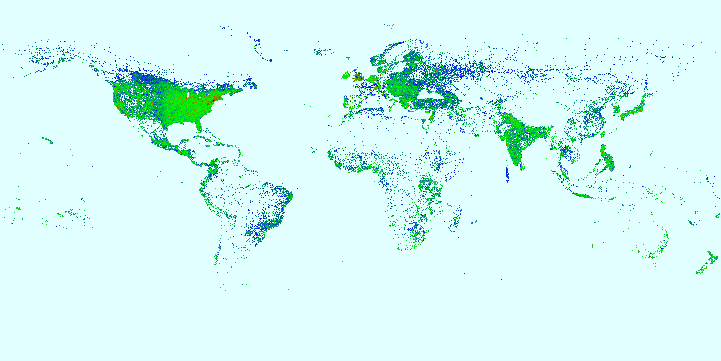
This is fascinating post on the Google Book Search blog, a Google employee did a world map mashup based on mentions of geographic locations in books, which he gleaned from Google Book Search.

There are also maps for different time periods which show the changing face of the world as expressed through published books. Cool Stuff.


via The Map Room
 

New Horizons slingshots past Jupiter


New Horizons has received it's gravity assist from Jupiter and is on it's way to Pluto. I was surprised to see how far from Jupiter the probe actually passes. When you think of a gravity slingshot, it seems that the probe would be grazing the surface to get maximum acceleration, when in fact it's still outside the orbits of the Galilean satellites at closest approach.

New Horizons set a record for fastest transit time Earth-to-Jupiter of just over a year.


Interplanetary Internet

A couple years ago, IEEE Spectrum did an article on the Interplanetary Internet, a concept for extending the terrestrial internet into space, and specifically for communications with assets in orbit and on the surface of Mars.

During Columbia's final mission, the first IP file transfer between an orbiting shuttle and the ground took place. Typically the exact route of a transmission, such as which ground station is to be used, is determined a priori. This was the first time the packet found it's way into orbit on it's own.

At the time of that article, internet pioneer and co-creator of TCP/IP Vint Cerf was related to the JPL group that held that it would not be possible to extend TCP/IP beyond low earth orbit due to the lengthy time delays involved, favouring instead the creation of a 'delay-tolerant-networking' protocol.

It seems this effort is now known as the InterPlaNet protocol.
 

The Fermi Paradox

The Fermi Paradox can be defined thusly:

The size and age of the universe suggest that many technologically advanced extraterrestrial civilizations ought to exist. However, this belief seems logically inconsistent with the lack of observational evidence to support it. Either the initial assumption is incorrect and technologically advanced intelligent life is much rarer than believed, current observations are incomplete and human beings have not detected other civilizations yet, or search methodologies are flawed and incorrect indicators are being sought.
(wikipedia).

The Space Review talks about a book on the paradox by Stephen Webb, where he delineates 50 possible solutions to the paradox, from autonomous alien weapons to the fact that we're alone.

There is also a new episode of the Universe Today podcast on the Fermi Paradox.
 

Charting our health by the stars

Charting our health by the stars is a study conducted in Ontario to find correlations between Zodiacal signs and health, to illustrate how easy it can be for a study to produce false results.

Their conclusion:

“There is a danger in basing scientific decisions on the results of one study, particularly if the results were unanticipated or the association was one that we did not initially decide to examine,” says Austin. “But when several studies all arrive at similar conclusions, we reduce the risk of arriving at an incorrect outcome.”


I would note that most news stories about science are actually reports of one-time studies with surprising results. Is any wonder that the public can dismiss science as fickle 'first they said this, now they say that' flip-flopping given the nature of how it is reported. You're rarely going to see a breaking news flash that there is now large-scale scientific consensus on a particular topic. Instead, you're likely to hear that a single study shows Cocoa may improve brain blood flow, or something similarly biased towards small dietary changes saving your life. At least, when it isn't an out-and-out human interest story.

Zodiac study via Wired.

Space paintings by Don Davis


Don Davis is a space artist who did several works for NASA over his career. Happily, he's released them on to the public domain on his website since they were publicly funded.

New Blogger

Decided to give the new blogger a whirl, and looking to reinvigorate this thing. Perpetuating the theory that 40% of all blog posts are along the lines of "I'm going to start posting more."

World's Oldest Person

It seems every couple months there is a cycle of stories about the world's oldest person passing away. I don't deign to disparage the morale crushing amount of research required to identify the world's oldest person. Perhaps these headlines should be "World's Oldest Person with Documentation Dies". At any rate, these stories must be the most egregious example of filling up a slow news day. I would think that the world's oldest person must be passing away every day, or every couple of days.

News organizations of the world, I ask you: Why limit yourself to reporting on the aged? You are missing out on the extremely gripping symmetrical tale of the world's youngest person being born. Breaking!

Pluto


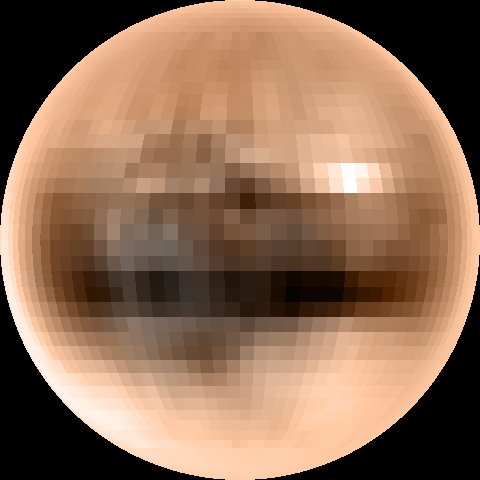
The roller coaster news coming from the IAU conference in Prague was no doubt confusing for the casual follower of astronomical developments. Earlier in the week, the news was trumpeted that the solar system may soon number 12 planets, only to be followed by the final decision that trans-neptunian objects including Pluto were out. The planets now number eight.

One of the most fascinating angles of this whole debate is how upside down people can get about how to draw boxes around nature's fuzzy edges. After first hearing of the initial proposal, I was skeptical. However I came to feel that a scientific definition for a planet would be difficult to create if it ruled out planets beyond Neptune simply because it offended our sense of aesthetic. I thought we'd just have to get used to the idea of planets coming in hundreds instead of a handful. Besides, other star systems could very well turn our well manicured collection of four terrestrials, four gas giants, and a collection of hangers on into an oddity, once they were observed in more detail.

A "planet" is defined as a celestial body that (a) is in orbit around the Sun, (b) has sufficient mass for its self-gravity to overcome rigid body forces so that it assumes a hydrostatic equilibrium (nearly round) shape, and (c) has cleared the neighbourhood around its orbit.


In the end the final resolution returns us to eight planets. I'm curious to see how easy it is to make the determination that a celestial body has cleared it's neighbourhood around its orbit. That seems like a very qualitative assessment to be making.

Again, the most fascinating aspect is the reaction of the general public. I find many reports in the popular press tend to give the impression that reality has somehow changed, rather than our description of reality. For instance, CNN's Pluto no longer a planet, say astronomers. It almost gives the impression that there was some kind of technical screw-up, rather than a rethink of a categorization system. I chalk it up to an educational system that puts more store in memorizing the names of nine planets, for regurgitation in an exam, polite company, or game show, than in understanding our reality as a complex entity that our classification systems attempt to simplify for convenience.


Chicago's Millenium park is stunning. I managed to get this night shot to turn out fairly well, looking northwest. Posted by Picasa

Nanobacteria

Every age thinks it's attained the ultimate understanding of how the
world works on some level. I can't find the quote right now from
1890, where a scientist declared that physics was a dead field. At
any rate, work on nanobacteria may prove interesting when it
plays out. Is it alive, or is it a crystal? They are implicated in
kidney stones and ovarian cancer.

British Library Images

The British Library is providing access to a database of their images, complete with keyword search. via Neat New Stuff.

Bertrand Russell - The Problems of Philosophy

Bertrand Russell has an engaging writing style that is very accessible. As a philosopher and thinker of the twentieth century a wide variety of his works can be found, such as the excellent History
of Western Philosophy


But to the point, I ran across an online version of The Problems of Philosophy, which I assume must be out of copyright judging from its publication date of 1912.

Buon giorno

I have lots of pictures of herculaneum and pompeii, but sadly nothing
here to plug the camera into. It was pretty interesting and not very
busy, althought things are a little chilly. We almost had herculaneum
to ourselves. Pompeii is huge. When I can put up some pictures I'll
have something more interesting to say.

Neaby Quasar?

A recent conference paper has revealed a quasar with a huge redshift, normally taken to indicate great distance and age, in the middle of a nearby spiral galaxy. If indeed the quasar is located nearby, as they assert, that will certainly have some major repercussions to established theory, I would think. I had thought that quasars were believed to be the most distant objects in the universe, because their high redshifts indicate high receeding speed, and thus distance. Will this affect estimates of elapsed time since the big bang? Maybe this is determined throught the cosmic microwave background, I'm not sure.

Maybe the quasar is moving away from us at high speed, but for reasons other than that which had been previously assumed. Apparently there is some correlation between quasars and other galaxy locations, so it will be interesting to see what comes of this.

Hello test


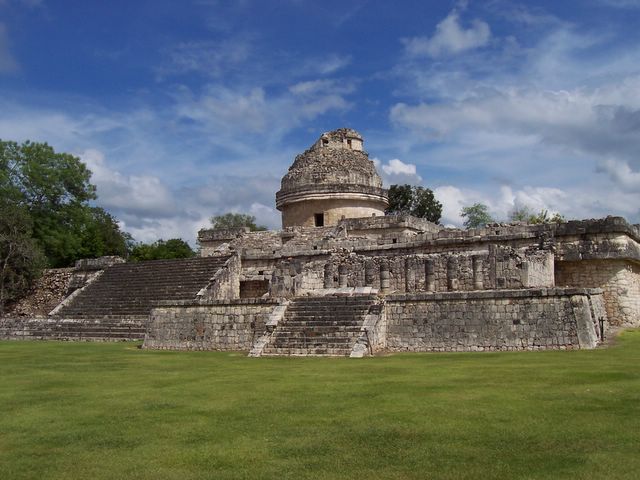
The Observatory at Chichen Itza Posted by Hello

Liquid Calcium

I just saw a commercial for toothpaste which includes liquid calcium. Is this really going to improve your dental health? They've added milk to toothpaste and this is going to build stronger teeth? Why not just drink the milk, it would probably be more effective.

The Opera Orange

I was thinking about the Orange on Sesame that sang opera, years ago. I think it was something from Carmen or the Barber of Seville. As I recall, an orange rolled out of a fruit basket and then aquired a face from other odds and ends on the counter, including an elastic band for a mouth. Then the orange starts singing. It's a soprano part, and at the end the final note is so high and loud that the face bits come flying off the orange. Absolutely terrifying.